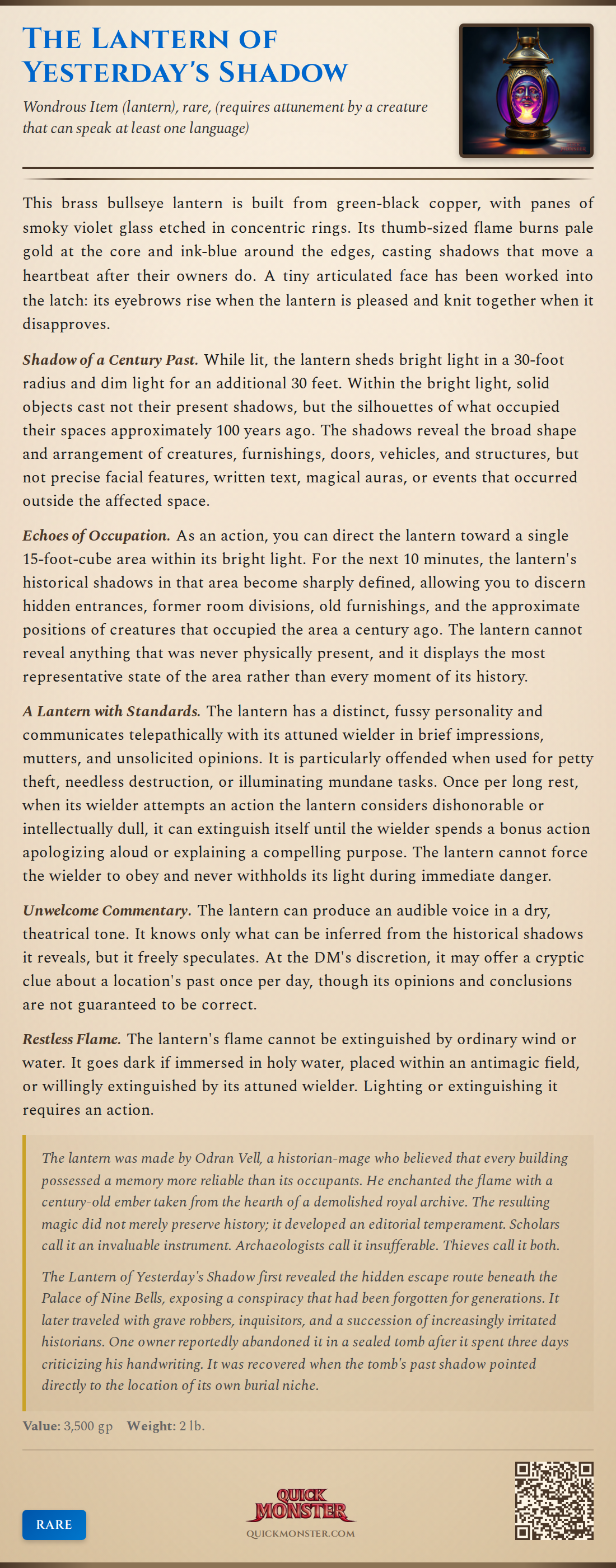
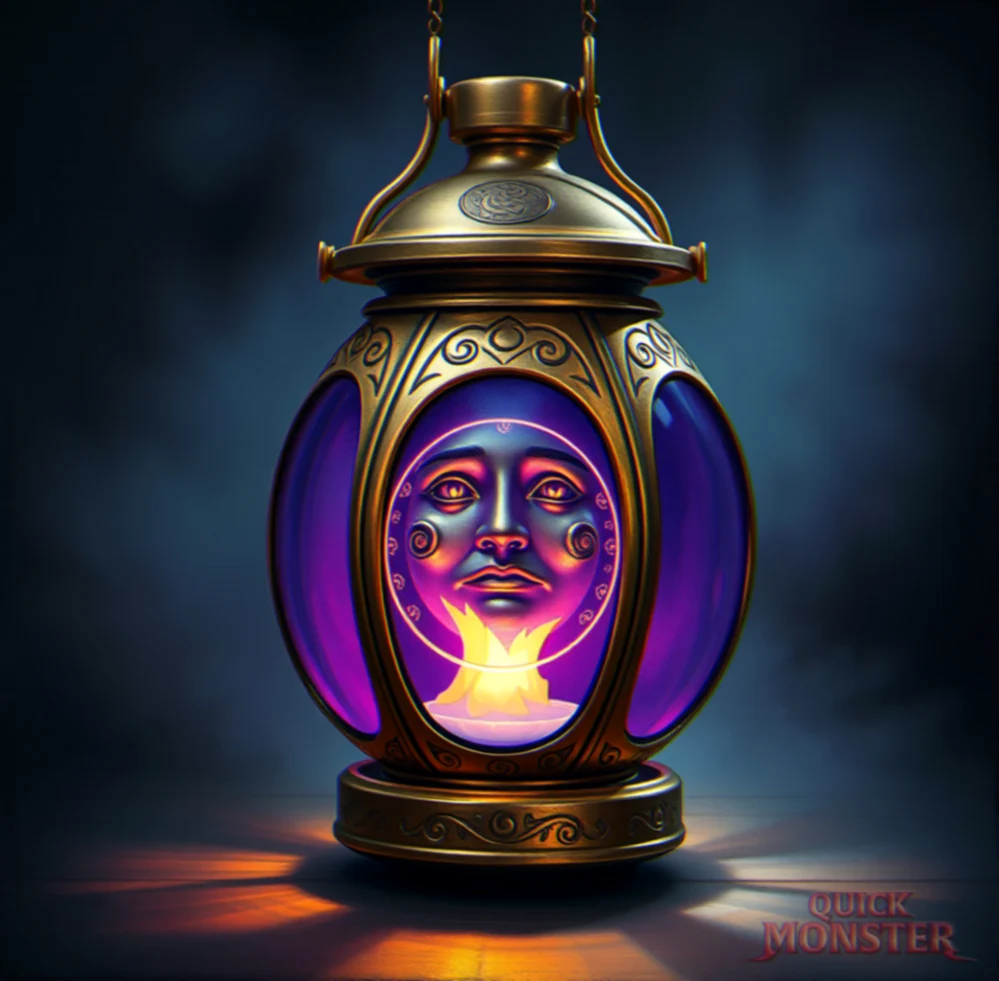
This brass bullseye lantern is built from green-black copper, with panes of smoky violet glass etched in concentric rings. Its thumb-sized flame burns pale gold at the core and ink-blue around the edges, casting shadows that move a heartbeat after their owners do. A tiny articulated face has been worked into the latch: its eyebrows rise when the lantern is pleased and knit together when it disapproves.
Shadow of a Century Past
While lit, the lantern sheds bright light in a 30-foot radius and dim light for an additional 30 feet. Within the bright light, solid objects cast not their present shadows, but the silhouettes of what occupied their spaces approximately 100 years ago. The shadows reveal the broad shape and arrangement of creatures, furnishings, doors, vehicles, and structures, but not precise facial features, written text, magical auras, or events that occurred outside the affected space.
Echoes of Occupation
As an action, you can direct the lantern toward a single 15-foot-cube area within its bright light. For the next 10 minutes, the lantern's historical shadows in that area become sharply defined, allowing you to discern hidden entrances, former room divisions, old furnishings, and the approximate positions of creatures that occupied the area a century ago. The lantern cannot reveal anything that was never physically present, and it displays the most representative state of the area rather than every moment of its history.
A Lantern with Standards
The lantern has a distinct, fussy personality and communicates telepathically with its attuned wielder in brief impressions, mutters, and unsolicited opinions. It is particularly offended when used for petty theft, needless destruction, or illuminating mundane tasks. Once per long rest, when its wielder attempts an action the lantern considers dishonorable or intellectually dull, it can extinguish itself until the wielder spends a bonus action apologizing aloud or explaining a compelling purpose. The lantern cannot force the wielder to obey and never withholds its light during immediate danger.
Unwelcome Commentary
The lantern can produce an audible voice in a dry, theatrical tone. It knows only what can be inferred from the historical shadows it reveals, but it freely speculates. At the DM's discretion, it may offer a cryptic clue about a location's past once per day, though its opinions and conclusions are not guaranteed to be correct.
Restless Flame
The lantern's flame cannot be extinguished by ordinary wind or water. It goes dark if immersed in holy water, placed within an antimagic field, or willingly extinguished by its attuned wielder. Lighting or extinguishing it requires an action.
Lore
The lantern was made by Odran Vell, a historian-mage who believed that every building possessed a memory more reliable than its occupants. He enchanted the flame with a century-old ember taken from the hearth of a demolished royal archive. The resulting magic did not merely preserve history; it developed an editorial temperament. Scholars call it an invaluable instrument. Archaeologists call it insufferable. Thieves call it both.
History
The Lantern of Yesterday's Shadow first revealed the hidden escape route beneath the Palace of Nine Bells, exposing a conspiracy that had been forgotten for generations. It later traveled with grave robbers, inquisitors, and a succession of increasingly irritated historians. One owner reportedly abandoned it in a sealed tomb after it spent three days criticizing his handwriting. It was recovered when the tomb's past shadow pointed directly to the location of its own burial niche.