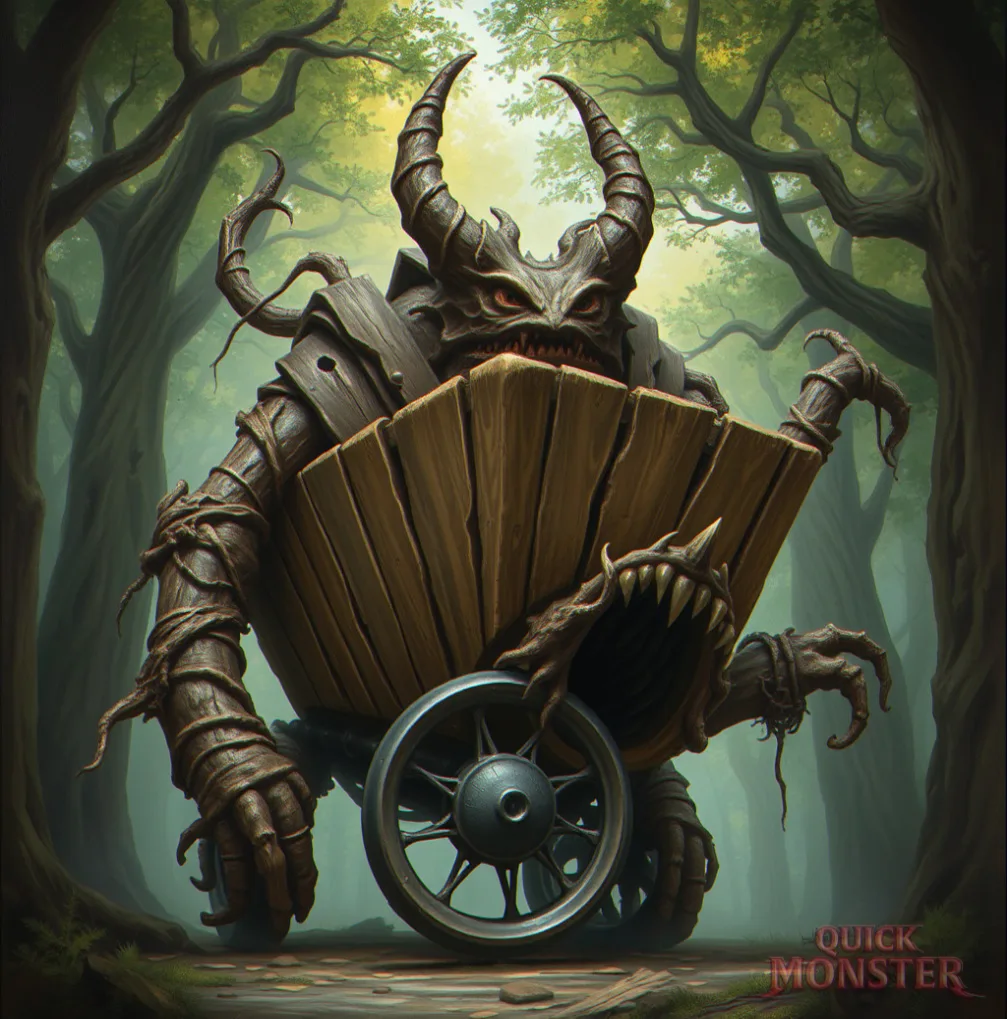
The Overdue Tollhouse
Armor Class 17 (natural armor)
Hit Points 136 (16d8+64)
Speed 20 ft.
Saving Throws Con +7, Wis +6, Cha +4
Skills Insight +6, Perception +6
Damage Resistances bludgeoning, piercing, and slashing from nonmagical attacks
Damage Immunities poison, psychic
Condition Immunities charmed, exhaustion, frightened, paralyzed, petrified, poisoned, unconscious
Senses darkvision 60 ft., passive Perception 16
Languages Common, one language known by its creator
Challenge 8 (3,900 XP) Proficiency Bonus +3
Actions
Bonus Actions
Reactions
📷 Export as Image
Share your monster as a beautiful PNG image styled like classic D&D sourcebooks.

Includes: Full stat block, monster image (if selected), CR badge, and QuickMonster branding.
Resolution: High-quality PNG at 2x scale for crisp display on any device.
"Payment is not punishment. It is simply what the road remembers." — The Overdue Tollhouse
Lore & Description
Appearance
The Overdue Tollhouse is a squat, weather-blackened booth assembled from oak beams, rusted iron, and faded red-and-white barrier stripes. Its windows glow with the amber light of an unseen lantern, while brass scales, clicking abacuses, and quills move behind the dusty glass. The entire structure stands on six short, jointed legs made from old bridge supports. A hinged service window opens like a mouth, revealing rows of nailed-in coins and a tongue of curling parchment. Its striped barrier arm functions as a club, and chains of stamped receipts spill from its foundations like metallic intestines.
Behavior & Origins
The Overdue Tollhouse was built by Magistrate Odran Vale at the old King's Cut, a road crossing where caravans once paid for safe passage through bandit country. When the road was abandoned, Odran's enchanted contract continued collecting tolls, then interest, then interest on the interest. The Tollhouse is not malicious; it is painfully sincere, believes agreements are sacred, and considers a fair fight a valid form of payment. It currently seeks the lost Golden Master Ledger, hidden beneath the ruined courthouse of Bellwether, because without it the Tollhouse cannot determine who truly owns the road. A clever party can earn its aid by recovering the ledger or proving that the crown's charter was legally revoked.
Running The Overdue Tollhouse
Tactics
The Tollhouse opens by declaring its terms, then uses Raise the Barrier to divide the party while it marks the most mobile or evasive creature as Delinquent. It keeps armored foes at reach with Shutter Slam and uses Chain of Receipts to restrain anyone who tries to flee, focusing its attacks on marked targets so interest compounds rapidly. When reduced below half its hit points, it offers one final renegotiation; if refused, it fights until destroyed, but it never attacks a creature that has honored its bargain unless that creature breaks the agreement first.
DM Tips
- Telegraph the encounter with fresh stamped receipts, coins arranged in neat stacks, and travelers' belongings hanging from the barrier arm with their debts written on tags.
- Play the Tollhouse as stern, literal, and almost bureaucratically polite; it pauses mid-battle to correct an incorrect total or explain a clause in the contract.
- For a weaker party, reduce Interest Accrues to 3 (1d6) psychic damage and lower the saving throw DCs to 14. For a stronger party, give the Tollhouse 30-foot blindsight through its receipt chains and let Demand Payment recharge on a 4-6.
- Reward inventive negotiation: waiving a debt, producing proof of royal exemption, or retrieving the Golden Master Ledger should grant safe passage and possibly make the Tollhouse a temporary ally.
Loot
- Golden Master Ledger — A heavy book of gilt iron pages containing every toll, exemption, and disputed charter from the old kingdom. It can prove ownership of several abandoned roads and estates.
- Barrier Stripe Splinter — A red-and-white sliver of enchanted wood that becomes a motionless barrier across any doorway for 1 minute once per dawn when a command word is spoken.
- Unclaimed Receipts — A bundle of stamped parchment slips bearing the names of long-dead travelers. One receipt names a living noble who has apparently owed the Tollhouse interest for three centuries.