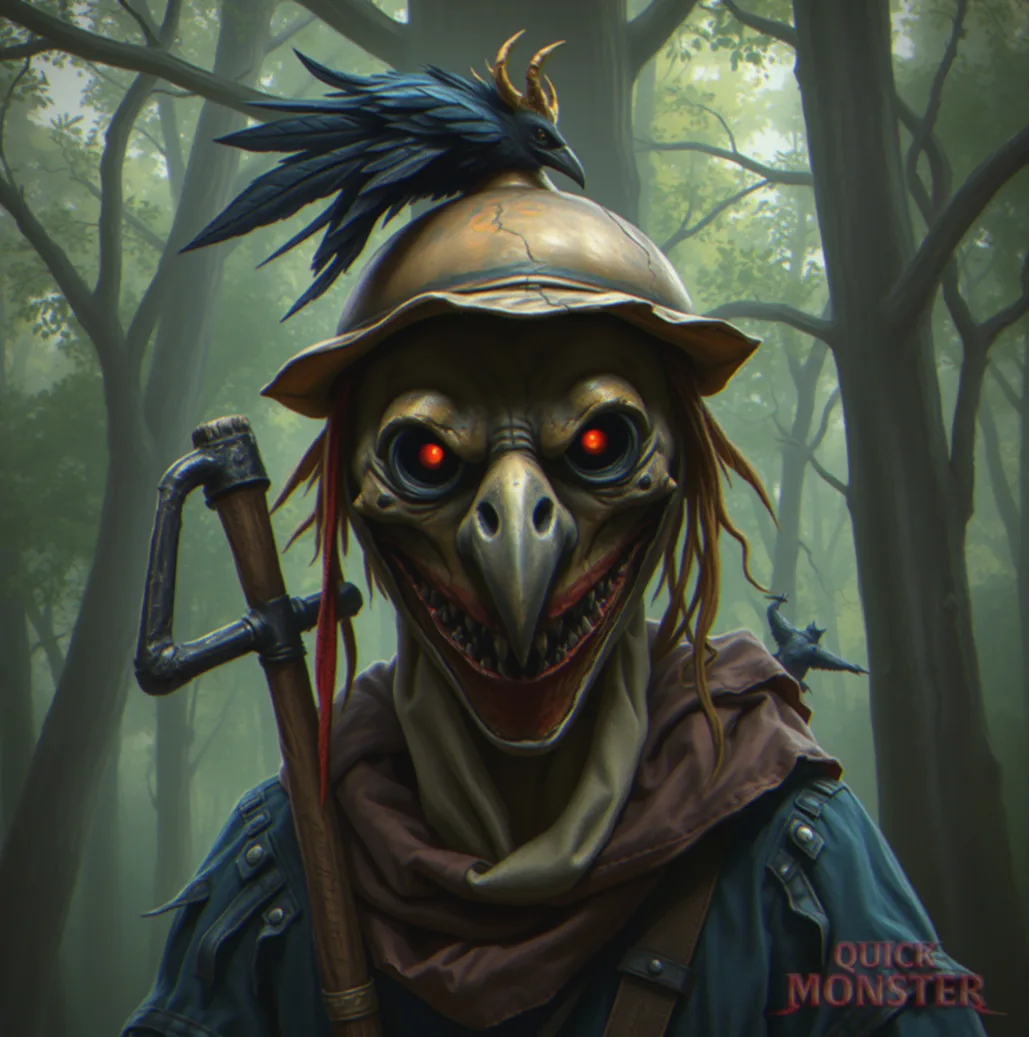
Grievance Warden
Armor Class 16 (patchwork armor)
Hit Points 136 (16d8+64)
Speed 30 ft. fly 40 ft.
Saving Throws Dex +8, Con +8, Wis +6
Skills Insight +6, Stealth +8, Deception +7, Persuasion +7
Damage Vulnerabilities fire
Damage Resistances bludgeoning; piercing; slashing from nonmagical attacks
Damage Immunities poison
Condition Immunities charmed, exhaustion, frightened, paralyzed, poisoned, unconscious
Senses darkvision 60 ft., passive Perception 16
Languages Common, Auran, telepathy 60 ft.
Challenge 10 (5,900 XP) Proficiency Bonus +4
Actions
Bonus Actions
Reactions
Legendary Actions
The Grievance Warden can take 3 legendary actions, choosing from the options below. Only one legendary action can be used at a time and only at the end of another creature's turn. The Warden regains spent legendary actions at the start of its turn.
Lair
Lair Actions
On initiative count 20 (losing initiative ties), the creature can take a lair action to cause one of the following effects; it can't use the same effect two rounds in a row:
- Minutes of the Meeting. A rain of written grievances fills a 20-foot-radius area the Warden can see within 120 feet. The area becomes heavily obscured until initiative count 20 on the next round, and creatures entering it or starting their turns there must succeed on a DC 16 Wisdom saving throw or be frightened until the end of their next turn.
- Unpaid Overtime. Up to three crows within the lair immediately move up to their flying speed and make one Blackwing attack against different targets.
- Management Retaliation. The Warden chooses one creature that damaged it since the previous round. That creature must succeed on a DC 16 Dexterity saving throw or be restrained by ropes, twine, and suddenly animated scarecrow limbs until initiative count 20 on the next round.
Regional Effects
The region containing the creature's lair is warped by its magic, creating the following effects:
- Within 6 miles of the Warden's roost, crows gather in organized flocks and refuse to obey farmers, hunters, or other traditional masters.
- Within 3 miles of the roost, every public notice, contract, and written complaint mysteriously acquires black-feather annotations.
- Humanoids who mock laborers, mistreat animals, or dismiss a plea for help hear distant cawing and suffer unsettling dreams of being stuffed with straw.
If the Grievance Warden dies, its union dissolves over 1d10 days, but one crow carries away the original grievance ledger. If the ledger is not burned or reconciled, a new Warden rises from the nearest abandoned scarecrow after one year.
📷 Export as Image
Share your monster as a beautiful PNG image styled like classic D&D sourcebooks.
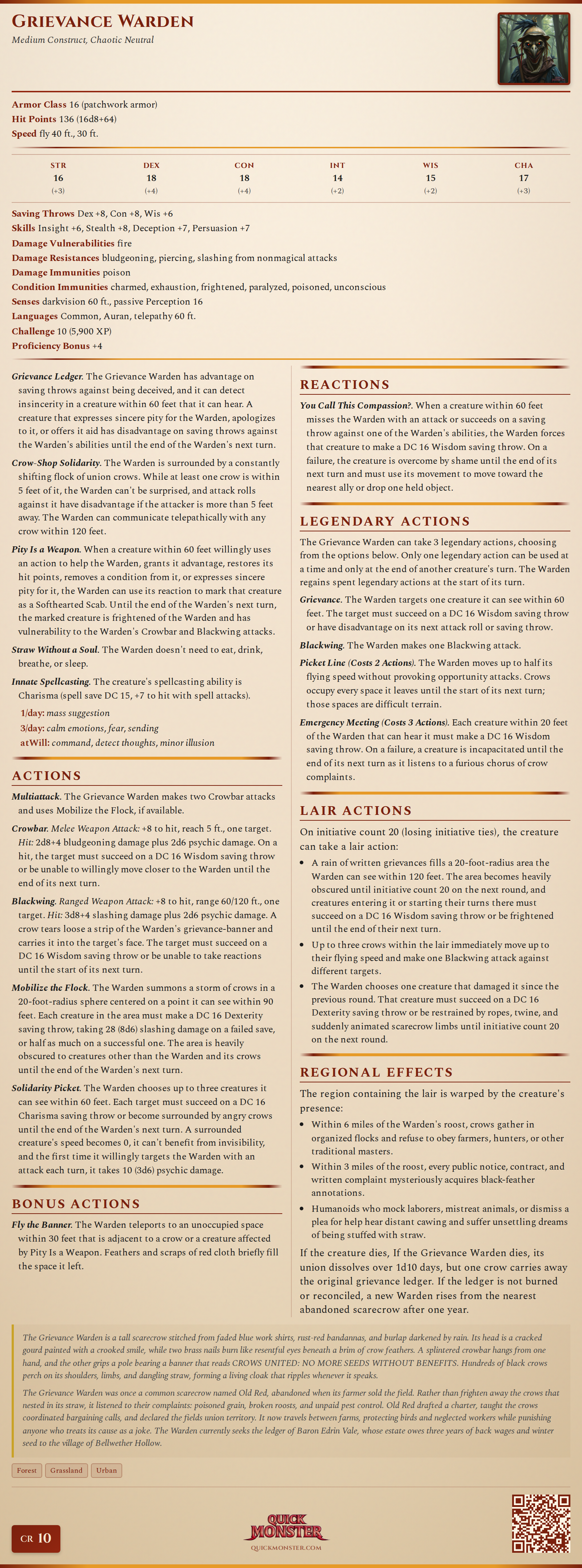
Includes: Full stat block, monster image (if selected), CR badge, and QuickMonster branding.
Resolution: High-quality PNG at 2x scale for crisp display on any device.
"We are not pests. We are stakeholders, and stakeholders have beaks." — Old Red, Grievance Warden
Lore & Description
Appearance
The Grievance Warden is a tall scarecrow stitched from faded blue work shirts, rust-red bandannas, and burlap darkened by rain. Its head is a cracked gourd painted with a crooked smile, while two brass nails burn like resentful eyes beneath a brim of crow feathers. A splintered crowbar hangs from one hand, and the other grips a pole bearing a banner that reads CROWS UNITED: NO MORE SEEDS WITHOUT BENEFITS. Hundreds of black crows perch on its shoulders, limbs, and dangling straw, forming a living cloak that ripples whenever it speaks.
Behavior & Origins
The Grievance Warden was once a common scarecrow named Old Red, abandoned when its farmer sold the field. Rather than frighten away the crows that nested in its straw, it listened to their complaints: poisoned grain, broken roosts, and unpaid pest control. Old Red drafted a charter, taught the crows coordinated bargaining calls, and declared the fields union territory. It now travels between farms, protecting birds and neglected workers while punishing anyone who treats its cause as a joke. The Warden currently seeks the ledger of Baron Edrin Vale, whose estate owes three years of back wages and winter seed to the village of Bellwether Hollow.
Running Grievance Warden
Tactics
The Warden opens with Mobilize the Flock to obscure the battlefield, then uses Blackwing and Solidarity Picket to isolate anyone who looks vulnerable. It deliberately accepts or invites pity from compassionate characters, marking them as Softhearted Scabs before closing with Crowbar attacks. When bloodied, it retreats into the flock, uses Fly the Banner to reposition, and fights to the death if its ledger or union banner is threatened; otherwise it flees to organize a new strike.
DM Tips
- Telegraph the danger with crows wearing tiny red threads, discarded weapons wrapped in grievance forms, and villagers who insist that the birds have better working conditions than they do.
- Roleplay the Warden as an exhausted labor organizer: it speaks in formal demands, calls characters 'management,' and becomes most terrifyingly calm when someone offers sympathy.
- Make pity mechanically meaningful but clearly telegraphed; the Warden should pause, soften its voice, and ask, 'You understand what it is to be used?' before triggering its cruelest response.
- For a weaker party, remove the legendary actions and reduce the flock damage to 21 (6d6); for a stronger party, give the Warden 30-foot blindsight through its crows and let Mobilize the Flock recharge on a 4-6.
Loot
- The Black Ledger — A waterproof book listing every broken promise, unpaid debt, and mistreated creature in the region. It can expose Baron Edrin Vale's crimes or serve as leverage in negotiations with the crows.
- Union Banner of Old Red — A patched red-and-black banner that grants advantage on one Persuasion check made to negotiate fair treatment for workers or animals each day. Crows become unusually attentive when it is displayed.
- Crowbar of Collective Bargaining — A mundane but perfectly balanced crowbar. Once per long rest, its wielder can cast command, but the command must relate to stopping work, opening a locked object, or lowering a weapon.